|
Trolley Benefits |
More Q&A |
How To Help |
Download Flyers
Questions and Answers
What are trolleybuses?
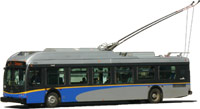
A trolleybus is a bus powered by electricity that is drawn from a pair of overhead wires. A distinguishing cahracterstic of trolleybuses compared to other transit vehicles are the twin poles (referred to as current collectors or trolley poles) that draw electricity from the overhead wires.
Trolleybuses run solely on electricity, similar to the LRT. They are used in over 360 cities in the world.
In Edmonton, trolleybuses are used mostly in central areas of the city. 46 core
neighbourhoods are served by trolleybuses. They carry around 7 million passengers annually.
^ Top
Why is this topic important now?
The trolleybus fleet is due for replacement. Several vehicle types are under consideration, including new low floor trolleybuses, low floor hybrid diesel buses, and regular low floor diesel buses. City council will decide the future of the trolleybus system this summer.
A decision to eliminate the trolleybuses would be irreversible, as it would be very expensive to put the trolleybus system back.
^ Top
Why are trolleybuses important to the transit mix today?
Oil prices have risen substantially in recent years. Leading economists and energy experts project oil prices of $300 a barrel by 2013—triple today’s pump prices.1 A transit system that relies exclusively on diesel buses will become increasingly vulnerable as prices rise. Electricity prices, by comparison, show relative stability because electricity is produced for a local market, not a world market. Since Edmonton owns the local electricity utility, but not the oil producers, there is greater benefit for Edmontonians in using electric energy over diesel fuel. Electricity is considered by most energy experts to be the primary long-term alternative to petroleum fuels; trolleys are a proven, long-term energy solution. The value of having trolleybuses will become ever more apparent as oil prices rise.
|
Oil Prices |
Power Prices |
| 2003 |
2008 |
2003 |
2008 |
| $30.99/bbl |
$97.87/bbl |
$0.063/kWh |
$0.078/kWh |
^ Top
Why are trolleybuses important to the community?
In some areas, trolleybuses pass by several hundred times a day in near silence and without adding any urban air pollution. They contribute to quieter communities and cleaner air in our streets. Because trolleys are used in the city core where the population density is greater, a lot of people benefit from their quiet and clean operation. Trolleybuses are considered to bring considerable quality of life benefits in cities where they are operated.
^ Top
If Council votes to keep trolleys, does it mean we keep the old trolley vehicles that we have?
No. The trolleybuses that we have are life-expired. A vote to keep trolleys means we would keep all or part of the trolley wire system. New low floor trolleybuses would be purchased.
^ Top
How do hybrid buses stack up?
Hybrid buses are marketed as a replacement for diesel buses, essentially as a way to lower emissions and improve fuel economy in certain types of service. The technology is steadily improving, but current models still lag in reliability behind new diesel and trolleybuses. They are viable on routes where it is not feasible to erect overhead wire, and they provide a short-term solution to energy pricing issues associated with the peaking and decline of oil production.
^ Top
If trolleybuses are cleaner, what about the power plant emissions?
There are emissions from power generation associated with trolley operation. But these emissions are not released into the streets in heavily populated areas. A well-known British study3 compared urban emissions to rural emissions and found that the health impacts of emissions released in the streets (urban) are an order of magnitude greater than the health impacts of rural emissions. The absence of in-street emissions with trolleys means they contribute to cleaner urban air, particularly in areas with frequent transit service like the city core.
Getting rid of trolleybuses in favour of hybrids or diesels is unlikely to affect power plant emissions at all. Power companies are in business to sell power and will simply sell the power to someone else. Thus, the net environmental impact of replacing trolleys with diesels or hybrids would be an increase in total emissions.
To address concerns with power plant emissions, the best option is to purchase zero-emission wind power for the trolley system, as Calgary does for its LRT. Wind power is a sustainable energy source and offers excellent long-term price stability.
^ Top
What about power or service
interruptions?
Newer-generation trolleybuses presently in the market have auxiliary power systems that they can temporarily run until power is restored. This makes them less vulnerable to power interruptions, and allows them to travel around obstructions such as accidents,
construction, or special events.
In any case, the power grid that supplies electricity to the trolley overhead network is separate from that used to supply electricity to homes, businesses and industry. This offers some protection to the fleet in an event of a power outage, and such outages are a rare
occurrence.
^ Top
Would eliminating trolleys save money?
Since the discussion about trolleys began in 2003, various claims of savings have been made. One constant has been that higher numbers are cited each time, which only serves to cast doubt on the reliability of the figures.
It is true that new trolley vehicles cost more than diesel vehicles to purchase, and there are expenditures associated with maintaining a network of overhead wires. But even with these additional costs, the trolleybus still ought to be viable on busy routes that haul large numbers of passengers and earn plenty of fare revenue, as Edmonton’s trolley system does. LRT provides a similar financial example: LRT is far more expensive than buses or trolleybuses, yet it is deemed viable by the large number of passengers it carries.
Two factors would improve the financial efficiency of trolley operations: expanding the system or increasing the number of trolley kms operated, or further increases in oil prices. The latter is almost guaranteed.
Scrapping the trolley system would result in the loss of an asset valued at over $89 million4 and the loss of an alternative to oil as prices inevitably rise.
^ Top
Would the city be better to invest only in LRT?
Light rail is designed for quick commutes across town; it is a “rapid transit” service. It is not a substitute for local bus service in those areas where trolleys operate.
Rising oil prices suggest the city is better off with more electric transit rather than less. In times of price instability, the sound investment strategy is to diversify. We need to diversify the fuels we use in our transport systems as much as possible, even if this requires additional investment. Any savings achieved by eliminating trolleys would be small and would not contribute significantly to LRT expansion. The potential long-term benefits of keeping trolleys are greater.
The trolley system is six times bigger than our LRT line. Building one km of LRT costs $100 million; building one km of trolley line costs around $2 million. Because of the high cost of building LRT, trolleys offer an opportunity to operate a bigger part of the transit system on electricity than would be possible if we only have LRT.
^ Top
What are other cities with trolleybuses doing?
In North America, there are nine cities that operate trolleys. Edmonton is the only city that has not yet purchased a new accessible trolley fleet. Some of the cities have expanded their trolley networks to varying degrees, as well. Vancouver is currently receiving an order of 262 new low floor trolleys and will invest over $8 million in extending its overhead wires over the next two years.5
The world trend shows an increase in the number of systems since the 1970s.
^ Top
Sources: 1. Economist Matthew
Simmons, Bloomberg, February 28, 2008; Energy Expert
Charlie Maxwell, Pacifica Riptide, February 2, 2008;
2. U.S. Energy Info Administration and Alberta Power
Pool. 3. Eyre, Ozdemiroglu and Steele, “Fuel
location on the damage costs of transport
emissions”, Journal of Transport Economics and
Policy (1997); 4. City of Edmonton 2006 Asset
Inventory; 5. Translink Board Meeting Minutes,
2007-08, www.translink.bc.ca

|
